Product Structure
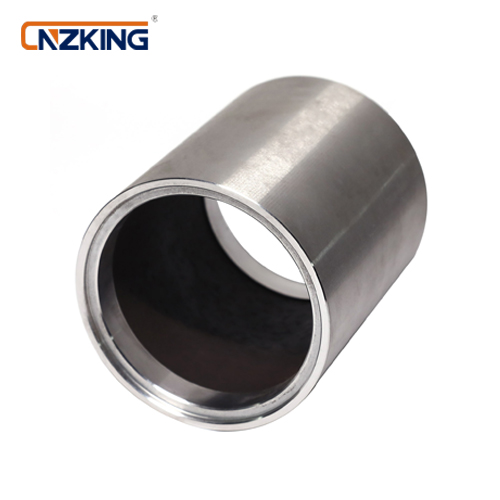
The slurry pump shaft sleeve features an integrated stepped cylindrical design. It is compact, offers high coaxial precision, and is compatible with various pump sealing chamber configurations. With no complex assembled parts, it allows for easy installation and removal. The structure comprises three core zones:
1. **Main Mating Section:** The sleeve's primary working area. The surface undergoes precision grinding and polishing to achieve high smoothness and precise roundness. It fits tightly against packing or mechanical seals, serving as the main wear-resistant and sealing surface to ensure a tight seal and smooth operation.
2. **Positioning Step Section:** Features an integrated stop shoulder at one end. During assembly, this shoulder abuts the end face of the wear plate or seal housing, ensuring precise axial positioning. This prevents axial shifting or misalignment during operation, guaranteeing overall assembly accuracy. 3. Inner Bore Section: The inner bore undergoes precision machining to ensure a clearance fit with the pump shaft. The inner wall is smooth and free of burrs, facilitating easy assembly while preventing wear caused by relative sliding. Additionally, a slight clearance is maintained to accommodate thermal expansion and contraction, preventing the equipment from seizing during high-temperature operation.
Standard part codes for industry-common Warman-series shaft sleeves typically end in "075" or "076." Common models include B075, C075, CH075, D075, E075, and G075, allowing for precise compatibility with the structural specifications of various slurry pumps and desulfurization pumps.
III. Mainstream Materials and Applicable Operating Conditions (Including Warman-Specific Material Codes)
Shaft sleeve material directly determines wear and corrosion resistance. Various specialized materials are selected based on the specific medium and operating conditions. Key materials exclusive to Warman pumps include C22, C23, and ceramic, complemented by conventional alloys to meet the requirements of all application scenarios:
1. C22 Material
A highly corrosion-resistant duplex stainless steel. It offers excellent resistance to acid and alkali corrosion, as well as strong resistance to chloride ions, weak acids, and weak alkalis. It combines moderate hardness with good toughness, making it resistant to cracking and deformation.
Applicable Conditions: Highly corrosive, low-abrasion environments such as power plant desulfurization slurry, corrosive chemical wastewater, seawater transport, and salt mining media. It is a primary material for desulfurization and chemical pump shaft sleeves.
2. C23 Material
An optimized version of the C22 material, enhanced for wear resistance and protection against particle erosion. It balances high strength, corrosion resistance, and wear resistance. With superior toughness, it withstands erosion from fine particles and resists scratching and pitting.
Applicable Conditions: Combined corrosion and mild abrasion environments, such as corrosive mineral slurries containing fine silt, wet desulfurization circulation pumps, and the transport of weakly acidic metallurgical slurries. It offers exceptional versatility. 3. Ceramic-Coated Material (Premium Warman-grade material)
Featuring a high-quality stainless steel substrate treated with a high-temperature ceramic coating process, this material offers extreme surface hardness and a very low coefficient of friction. It boasts four key advantages: superior wear resistance, strong corrosion resistance, scale resistance, and high-temperature tolerance. The surface is smooth and dense, preventing medium adhesion and associated wear.
Suitable Applications: Demanding conditions involving high wear, high cleanliness requirements, and high temperatures—such as quartz sand processing, high-hardness tailings transport, high-temperature desulfurization media, and precision fluid transport. Its service life is 3–5 times that of standard alloy sleeves.
4. 3Cr13/4Cr13 Stainless Steel
A standard alloy material offering high hardness, stable wear resistance, high machining precision, and excellent cost-effectiveness. It provides basic rust and mild corrosion resistance, making it suitable for the vast majority of standard industrial applications.
Suitable Applications: Standard operating conditions with moderate wear and no strong corrosives, such as coal washing plants, general mine tailings handling, and sand/gravel transport. This is the standard material for general-purpose models.
5. 304/316 Stainless Steel
Grade 304 focuses on basic rust and corrosion resistance, offering good toughness and resistance to deformation; Grade 316 includes added molybdenum, significantly enhancing resistance to acids, alkalis, and chloride-ion corrosion.
Suitable Applications: Transport of clean water, mildly corrosive wastewater, and clean media with low particulate content. Ideal for light-duty applications where wear is minimal and the priority is rust and corrosion prevention.